(Cutline for the photo used in the header: Jack McFarland speaks to Winnfield Kiwanis)
Jack McFarland told the Kiwanis club that when he was in school is was not his dream to be an elected official. He does not use the term politician because that has negative connotations for him. However, he said it is a privilege to represent us. One thing he is fighting for is to keep the Louisiana Political Museum in Winnfield because there are people who want to move it to Baton Rouge.
He spoke about redistricting. There are still legal challenges but changes to District 13 include all of Winn, all of Jackson, some of Bienville and the northern part of Natchitoches parish. McFarland played a role in drawing the district. He wanted all of Winn parish in District 13.
McFarland is on the Republican State Central Committee, chairman of the House Ag Committee, Chairman of the Conservative Caucus and on the appropriations committee. He is running for Speaker of the House. It has been 45 years since North Louisiana had a speaker of the house. That was Bubba Henry from Jonesboro. The Speaker of the House gets $40 million for his district.
McFarland spoke about the expenditure limit which was set to control spending. He believes that you can’t spend non-reoccurring money on things that reoccur every year. Non-reoccurring money came from American Rescue Plan, Covid, Hurricanes Laura and Ida. That was money that will no longer be given.
McFarland spoke about being called to the governor’s office to talk about his vote and how to get his vote. He votes his district. To find out how his district feels about certain things he talks to the people in his district who are involved in those things-the sheriff, the district attorney, teachers, bankers, judges, etc. The Fortified Roof Program is something he wants which is $40 million. It offers grants to people to fortify their roofs and in turn it will lower insurance cost to residents. There are over 500 bridges in District 13 and he wants money for the preservation of those bridges and roads. He is not concerned about adding new roads in South Louisiana.
Unlike the past years the legislative session now requires working 7 days a week. When he started in the legislature you went home on the weekends but those days are gone. In the legislature he is concerned with water, sewer, infrastructure, and education. He wants to be fiscally responsible for his district.
McFarland is eligible for one more term and he is running for reelection.
The Winn Parish Journal is pleased to announce that readers can look forward to knowledgeable coverage of WSHS football this fall thanks to the writing contributions of Daniel Simmons. The 2020 graduate of WSHS played varsity football as a tight end for the Tigers for the 2017-19 seasons under head coach Lyn Bankston.
Just like a trailer for an upcoming movie, the Journal has a preview of our coverage. Simmons covered a recent all-Tiger 7-on-7 here and filed the following report:
WSHS Football Participates in Home 7-on-7 with LaSalle and Montgomery
Tuesday evening, June 20, at Stokes-Walker Stadium, the Winnfield Tigers hosted the Tigers from LaSalle High School and the Tigers from Montgomery High School for their first 7-on-7 of the season. As the name might suggest, 7-on-7 football is not played with a full squad of 11 players on the field at a time. The purpose of a 7-on-7 is for the quarterbacks and receivers on offense and the linebackers and defensive backs on defense to get extra practice against other teams. The only lineman involved is the center, to hike the ball to the quarterback. Score is not kept in a 7-on-7; it is more of a glorified practice with other teams.
The hometown Tigers fought through the intense heat and humidity and made plays on both sides of the ball. They reached the end zone several times on offense, even connecting on a few deep passes for touchdowns. Defensively, they intercepted a few passes and made several other stops. Overall, it was a solid first outing for the 2023 edition of Winnfield Tiger Football.
“We have four 7-on-7s scheduled for the summer,” said WSHS head coach Jay Watson. “They are really good practice for us defensively, as a lot of other teams are spread offenses and throw the ball quite often. We feel like we are solid on five of our seven starters in the back end of our defense, and they have shown improvement through competition. We are rotating guys to see what our best combinations are that will give us the best chance to stop people this coming season. But that stuff is just playing football in P.E. shorts. We’ll know more in August when we strap it up.”
Speaking of strapping it up, the real football season is right around the corner, a little bit less than two months away. Winnfield will open its season with an away game on Friday, September 1, where they will take on the Pineville Rebels.
Simmons will be filing more pre-season stories including interviews with Coach Watson on his season preview as well as details on the Tiger coaching staff and Jamboree action. Read about the full action in the Winn Parish Journal.
Bob Holeman conducted this series of interviews with local World War II veterans in 2011-12. Most of these 34 American heroes have passed away in the decade since).
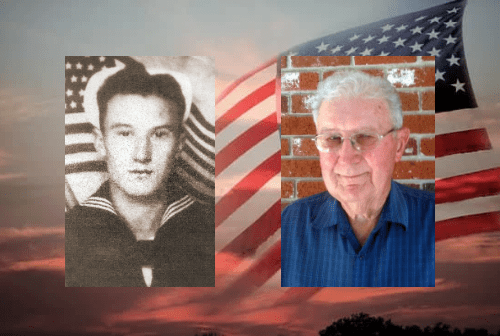
H.L. Caskey explains that he, like most veterans of World War II, experienced the entire gamut of emotions during his years of service: anxiety, fear, uncertainty, happiness, triumph.
This 18-year-old boy, a Navy welder working below deck when his ship was attacked for the first time by the enemy, admits his initial concern. But in attack after attack, Caskey said he got madder and meaner to the point where he wasn’t fearful, only focused on his duty. (He’d also talked his way to topside). Yet he believes that his most heart-touching moments came in Tokyo Bay in 1945 when he saw the liberated American soldiers, gaunt from starvation and abuse from their Japanese captors.
Henry Leslie Caskey Jr. was born May 4, 1925, to Leslie and Fannie Caskey. They were living in Waxahachie, TX, at the time but shortly moved to the Cypress Creek area where young H.L., the eldest of nine, began his schooling. His father supported his family as a logger. When that community school was closed, the Caskey kids attended Dodson High School.
Caskey has a strong build but says there weren’t many sports opportunities in the rural school at the time. “I did OK in my studies, as far as I went. That was just through the 9th grade, though. Pearl Harbor happened and I figured I could be more use in the war effort if I learned a trade. I went to the trade school in Alexandria to learn welding. I could make money at the shipyard in New Orleans. Chopping cotton didn’t pay but 50 cents a day and I’d had enough of that.”
He recalls that “Fatty Bass, a big man, came by my house looking for boys, women and all to learn the trade and build ships. All the men were in service. I loaded up with him and went right then.” After only five weeks in Alexandria, this fast-learning teen from the cotton patch was moved on to New Orleans for advanced training. He lived in a dormitory while he learned all possible welding methods.
The pay was good, too. From 50 cents a day on the farm, he went to $17 a month in Alexandria (with all the food he could eat plus a place to sleep). But once he was trained and working in the shipyard, this boy was in high cotton, indeed, at $120 per week. He sent a lot of that money back home to help support his family. This was November 1942.
“We built sea-going tugboats,” said Caskey. “Now I’m not talking about those tugs you see on the Mississippi. These were as big as some of those warships. They’d go out and tow crippled ships. We finished a couple of those in a little over a year that I worked there.”
“When I turned 18, I wanted to come home for a while. I went by the Selective Service Office to say I preferred the Navy and see how long it would be before I was called up. ‘Right now, if you want,’ they said. I didn’t want to go that quick but it wasn’t long before I got the call.”
So in fall 1943, Caskey was processed through Fort Humbug in Shreveport. Following a couple of days of leave, he was put aboard a freight train to San Diego for basic training. That didn’t take long and by Christmas he was aboard a ship bound for the Pacific. “When the ship first came in, it had holes in it they were patching. I had a good idea where we were heading. I was pretty young but I was the ship’s welder. There was an older welder who’d been on board but he was taking leave.”
The first action Caskey saw aboard the USS San Juan, an anti-aircraft cruiser, was New Georgia. The cruiser would be involved in 12 other battles as they made their way to Tokyo Bay. (Cited engagements were Treasury/Bougainville, Gilbert Islands, Marshall Islands, Asiatic-Pacific Raids, Western New Guinea, Marianas, Leyte Gulf, Luzon, Iwo Jima, Okinawa, Third Fleet Strikes on Japan and the Philippine Liberation).
“None of the battles were good. I’d say Okinawa and Iwo Jima were the worst. The Japanese knew the end was getting close so they came at us with those kamikaze planes. They figured they were going to die anyway so they wanted to take us with them.”
The veteran revealed, “At first, I didn’t know when we would start shooting those big guns, with 5-inch shells. Everything is quiet, then all of a sudden, boom. Maybe that didn’t bother me so much. What did bother me was that my station was below deck in the repair division. I couldn’t see what was going on. Finally I was able to move topside.”
While Caskey described his daily jobs as small. One time the cruiser bumped the side of a larger ship and salt water began leaking into a fresh water tank. He welded for two days straight but the outside water pressure was too great to overcome. They finally sealed off the tank and allowed it to fill with salt water. Other fresh water tanks were still available.
Shortage of food was no problem, “for what it was,” said Caskey. “Horse meat for breakfast, powdered eggs and plenty of bacon. We had good cooks who made fresh bread every day. There was a big kitchen with two galleys. In battle, they made sandwiches. Sometimes you’d stay at general quarters for two or three days in a row.”
When the war ended, as the cruiser moved into Tokyo Bay, they spotted two allied prisoners of war swimming and waving for help. “They were Brits who’d jumped in and started towards the ship, thinking they were closer than they were. What got me was when we picked them up, they looked so poorly. They didn’t have a rag of clothes on and they were just skin and bones. I didn’t think anyone could be so poorly and live. To welcome the POWs, the ship’s cooks fixed two tables of every possible food they might want. But they’d been so starved for so long, they could only eat a handful.”
The liberating military teams went ashore and began freeing POWs in the many internment camps in the area. Everybody wanted to help. In the camps, condition was no better. The excitement of liberation was too much for some of the Americans who died while they were being taken out. “Seeing those POWs was the most heart-touching. They’d starved them to death.” Caskey was not part of the liberating force ashore and the San Juan saw only those two British POWs but he said the clearing of the prison camps was accomplished in less than a week.
As the war had progressed, Caskey said, the men had become calloused to their initial fear. “After a while, you accumulated something that made you meaner and meaner. You didn’t want to hide from the enemy attacks…you wanted to be involved. You know, it took me 60 years to get over that hate. I finally asked the Lord to let me forgive. I didn’t talk about my experiences for the longest time. My kids could look at the books and photos but we didn’t talk, except some to my son, David. Finally, when the grandkids came along and asked questions, I began to talk about the war.”
This veteran not only recalls where he was when news of the war’s end was announced, he had the presence of history to find his ship’s photographer friend to take a picture of his crew. “I was still up when word came through on the radio. I went around, waking up men with the news. There was this one guy who’d said when the war was over, he was going to fall down on his knees on the hatch and praise the Lord. When I gave him the news, he did.”
The San Juan was still in Tokyo Bay when the unconditional surrender was signed aboard the USS Missouri. Not long after, they sailed home, escorting a hospital ship filled with freed American POWs. Once stateside, Caskey became anxious as he watched virtually all of the crew getting discharged and going ashore. “It looked like I was fixing to go back to Japan so I went to see my friend, Lt. ‘Dusty’ Rhodes, who’d go on to become the ship’s captain. He wanted to keep me on but I said, ‘Lieutenant, I came to do a job but I’m finished. I’m not going back.’ Within 15 minutes, an announcement came over the speakers, ‘Seaman First Class Caskey, come down to quarterdeck.’ In another 30 minutes, I was gone.” He was discharged in New Orleans Dec. 16, 1945.
By then, his parents had moved on to Oak Grove. Caskey tried his hand at growing a cotton crop there, but only briefly. Thanks to the Navy, he had a marketable trade skill and went to work in a shipyard, as he had started. Only this time is was one in Galveston. Still not settled, he moved on to help in the reconstruction in Texas City that had been devastated in April 1947 when two cargo ships exploded at the terminal. He then went with the Brown & Root construction of a Dubach refinery. In 1951, he moved to pipeline work with Pipeline Union 798 and traveled all over the United States, Canada, Alaska, South America, Persian Gulf and Egypt (where he left in a hurry when he saw the 6-Day War unfolding).
Following a full career in the pipeline business, this veteran wasn’t finished with work. He built a machine shop, then began Caskey Drilling and then went into logging.
Caskey first met Dorothea Durbin from Brewton’s Mill in July 1943. When they first met before his service, “he seemed like quite a catch. He had a shiny new 1937 Ford with plenty of passengers, new clothes and coins in his pocket. He came home in December 1945 and we were married April 1, 1946. Maybe we should have thought about what that date means. We eloped. I’d ordered a wedding dress and picked it up when it came in. Only my big sister, Aubyn, knew and helped in the planning. We ran off and got married in Bro. Stokes’ home.”
It obviously worked out for the best. Now a couple for over 66 years, they had three children, Donna, “who came along nine months later,” Cheryl and David. They have seven grandchildren and 17 great grandchildren, ages 13 on down.
“We give God the credit for all that has happened in our lives,” Caskey concluded. “We’ve been blessed.”
Whether it’s during the heat of summer or the chill of winter, volunteers at the Community Food Pantry are ready to serve local families who need a little help putting food on their table. Once every four weeks, enrolled families can come to the First Presbyterian Church (right across from Southern Funeral Home) to receive a free bag of groceries. They also get a little something extra which volunteers call “Lagniappe.”
This community service has been taking place for decades, not so much as a service of the church but through a network of volunteers from many churches and faiths. Those who are enrolled keep coming back on a regular basis. Those who wish to take part are invited to simply arrive during the Food Pantry’s Thursday operating hours to come in and bring an ID and some proof of income. “We don’t want to turn anyone away,” say organizers.
The Community Food Pantry here in Winnfield is open each Thursday from 12:30 until 2:30 p.m. The plan is so simple that recipients receive curb service. They drive up to the church and park. Volunteers come to the car to confirm their registration and bring them a bag of groceries and Lagniappe. (As mentioned above, newcomers should come inside for their initial registration).
This delivery plan was developed during the COVID years when the Food Pantry developed this system of safely delivering groceries without missing a single week of service.
It was also noted that the Food Pantry always welcomes new volunteers for the many aspects of the process: registration, bagging groceries or Lagniappe, delivering to cars, sorting and stocking shelves, breaking down boxes, record keeping or just generally assisting. Getting involved is as simple as walking in during operating hours and saying, “I’d like to help.”
With the faint rumble of the 4th of July fireworks in our past, it is time to get ready for VBS!
“Keepers of the Kingdom” is the theme of the Goldonna Baptist Church’s Vacation Bible School. VBS will be in full swing from July 9-12. VBS is always a staple of a child’s summer schedule and you do not want to miss out on this one.
Goldonna High School Reunion will be held July 8 at 10:30 at the Goldonna Baptist Church fellowship hall. A delicious catfish luncheon will be served. The contact person is Mrs. Linda Dupree. If you were a graduate of Goldonna High School, in any class, please make an effort to come visit with your classmates.
On July 22, the youth at Goldonna Baptist Church will be holding a Wiffle Ball Tournament to benefit the Operation Christmas Child shipping costs. Each team should consist of six players, the tournament will only allow for twelve teams.… hurry fast with your registration. The entry fee is $60 and there is a double elimination. Wiffle balls and bats will be provided. There will be boxes available to bring your Operation Christmas Child items for donations. Concessions will be served and there will be a waterslide available for a fee of $10 for all-day access. This event promises to be loads of fun.
Goldonna Assembly of God will be hosting a Revival titled, “Seed Sowers”. Services will begin at 6:30 on July 21-22. July 23, services will begin at 10.
River of Life Family Worship Center held its 4th of July Celebration on Sunday, July 2. The church enjoyed a covered dish meal with lots of fellowships.
NATCHITOCHES – An economic impact study has placed Northwestern State University’s economic value at $519.7 million in income and determined that the school supported 7,204 jobs in northwest and central Louisiana during fiscal year 2021-22.
The findings were reported by Lightcast, an independent labor market analytics firm. “Results of this study highlight the return on investment the university creates for students, for taxpayers and for society,” said NSU President Dr. Marcus Jones. “NSU supports economic development through education, workforce development and improved quality of life for residents of northwest and central Louisiana and around the state.”
According to the study, as a primary source of higher education in region, Northwestern State supplies trained workers and enhances overall productivity in the regional workforce. The university promotes economic growth through direct expenditures by visitors, students and regional businesses and as an employer and buyer of goods and services for its day-to-day operations. Numerous spin-off companies have formed as a result of knowledge and innovation at NSU. Activities at the university attract students and visitors from outside northwest and central Louisiana whose expenditures benefit regional vendors. NSU students and employees volunteer in the community to help businesses and organizations grow. Financial impacts are broken down as follows. · $75 million in operations spending · $104.3 million in spin-off company impact · $11.8 million in visitor spending · $10.1 in student spending · $7 million in volunteerism · $311.6 million alumni impact
Put in context, the $519.7 million impact was equal to approximately 1.5 percent of the total gross regional product (GRP) of northwest and central Louisiana. The study finds that NSU supported one out of every 53 jobs.
NSU’s FY 2021-22 students paid a present value of $70.4 million to cover the cost of tuition, fees, supplies, and interest on student loans. In return for their investment, students will receive a cumulative present value of $860.7 million in increased earnings over their working lives. This translates to a return of $5.10 in higher future earnings for every dollar students invest in their education.
From a taxpayer perspective, NSU generates more in tax revenue than it receives. For every dollar of public money invested in NSU, taxpayers will receive a cumulative value of $2.40 over the course of the students’ working lives. By the end of the FY 2021-22 students’ working lives, the state government will have collected a present value of $50.7 million in added taxes.
Visitors attracted to Louisiana for activities at NSU brought new dollars to the economy through spending at hotels, restaurants, gas stations and other businesses. That spending added approximately $11.8 million in income to the regional economy, the equivalent of 278 jobs.
Louisiana as a whole benefits from Northwestern State in two ways, the study finds. First, the higher economic base attributed to the added income from students’ increased lifetime earnings raises economic prosperity. Second, savings generated by improved lifestyles include avoided medical costs, justice system savings and reduced welfare and unemployment claims.
Jones said findings from the study will be important to stakeholders, legislators, industry partners and organizations focused on economic and workforce development in illustrating how the university creates conditions for economic prosperity.
“Data from this impact study underlines the value of Northwestern on an individual level, the community level and state level,” Jones said. “It is critical that we use the information to continue to be proactive in engagement and market responsiveness, good stewards of our assets and strategic in economic development initiatives.”
(Author Leah Jackson is Northwestern State University’s Director of Public Information and Media Relations).
Sunday afternoon, Kay and I were driving home after a special Father’s Day lunch in town, and as I glanced toward the pasture across the road from our home, something caught my eye. It was a tiny fawn standing within a few yards of the pasture fence. I stopped, lowered the window and snapped a few photos of the little fellow before it wandered off across the pasture. I posted a snapshot of the little deer on Facebook and within an hour, there were responses from others around the region who had also seen newborn fawns. “We saw one about 20 minutes ago, less than a few hours old”…”I saw one outside of Tullos in Winn Parish last Wednesday.”….”One was in my yard.”…”My husband saw two today here in the woods.” What does this all mean? You don’t have to be a wildlife biologist to realize that this is the time of year when fawns are being born in our area. Every year about this time, I receive a press release from the Louisiana Department of Wildlife and Fisheries (LDWF) reminding people who encounter what appear to be abandoned young deer alone in the outdoors that those fawns should be left undisturbed. Here’s how the press release reads…”Every year the department receives calls from concerned citizens who have found what they consider to be “abandoned” fawns. Well intentioned, concerned citizens sometimes bring fawns home and then call the department to retrieve and raise them. “LDWF is alerting the public that it is against the law to capture young deer or any other wild animal. If caught transporting or possessing wild deer without a permit, well meaning individuals may be subject to citations and fines.
“Picking up fawns seriously diminishes their chance to live a normal and healthy life. When a fawn is born, it is weak, awkward and unable to move well enough to feed and escape predators. However, the newborn fawn has a coat of light brown hair liberally covered with white spots that provides excellent camouflage against predators. The mother doe will remain in the area to feed and nurture the fawn. When the young deer gets older and stronger it will be able to forage for food with its mother.
“When encountering fawns in the wild, simply leave them untouched and depart quietly from the area. This action will provide the young deer its best chance to survive in the wild and prevent a possible citation for a well-intentioned outdoorsman.
“There have been too many cases of kind-hearted folks picking up what they believe to be an abandoned fawn and with the idea of keeping it as a cute little pet. There have been numerous reports of that sweet little creature becoming aggressive and dangerous once it reaches maturity.
“If it is confirmed that the mother has in fact died, such as seeing a fawn next to a road-killed doe, what you should do is call the LDWF and report what you find. There are facilities that are licensed to take in such baby animals.”
If you should chance to walk up on one in the weeds or next to a log, snap a photo if you would like and back away slowly. The doe is likely peaking through the brush somewhere nearby and is probably watching you to see if you are a threat to her baby. Once things settle down and you leave, she’ll return and the little one will follow her away.
It’s tempting I know to have compassion on what seems to be a helpless little baby deer and rescue it from harm when in fact, this is Mother Nature’s way of taking care of the situation. Mother doesn’t need your help.
Date: 6-25-23 Name: Chasta A Rasberry Address: Jonesboro, LA Race: White Sex: Female Age: 37 Charge: Bench warrant (Sentence review)
Date: 6-26-23 Name: Linda Maples Address: Winnfield, LA Race: White Sex: Female Age: 47 Charge: Bench warrant (trail)
Date: 6-27-23 Name: Garland Walker Address: Winnfield, LA Race: Black Sex: Male Age: 33 Charge: Criminal trespassing, Terrorizing
Date: 6-29-23 Name: Omeka Foster Address: Winnfield, LA Race: Black Sex: Female Age: 45 Charge: Theft (felony)
Date: 6-30-23 Name: Darin Hemphill Address: Dodson, LA Race: White Sex: Male Age: 57 Charge: Operating while intoxicated (3rd Offense)
Date: 7-1-23 Name: Anthony Goff Address: Winnfield, LA Race: Black Sex: Male Age: 40 Charge: Simple criminal damage to property, Disturbing the peace, Illegal possession of a firearm, Aggravted assualt with a firearm, Terrorizing
This information has been provided by a law enforcement agency as public information. Persons named or shown in photographs or video as suspects in a criminal investigation or arrested and charged with a crime have not been convicted of any criminal offense and are presumed innocent until proven guilty in a court of law.
Samuel James Friedman January 4, 1937 — July 2, 2023 Service: Friday, July 7 at 11:30 am at the Natchitoches Events Center
Terry L. McQuillin Sr. July 13, 1950 — July 2, 2023 Service: Wednesday, July 5 at 2 pm at Blanchard-St. Denis Funeral Home
Elories “Honey” Helaire Johnson July 4, 2023 Arrangements TBA
Alma Corine “Corey” Morris Creighton February 16, 1951 — July 1, 2023 Service: Friday, July 7 at 10:30 am at the Family Worship Center, located at 330 Sandy Point Rd in Campti
Anita McGee Service: Saturday, July 8 at 2 pm at Calvary Baptist Church in Natchitoches