Angler’s Perspective

Making Babies

For a bass angler, this is the best time of the year to fish. The early spring and warming water temperatures bring big bass shallow in order to make babies. This is a time of year known by bass anglers as the “spawn.” It’s when bass come out of their deep water winter haunts and start the process of producing young fry (baby bass). Many an angler has laid awake at night dreaming of catching that fish of a lifetime during the months of late February, March and April. While there are some fish that live shallow year around, there’s also a group of bass that live deep all year long until Mother Nature says “go make babies.” This is when your bigger female bass pull into the shallow waters and become more susceptible to being caught while making beds and laying their eggs when conditions are right.

Now some northern states have rules that prevent anglers from fishing during the spawning season and will actually close their lakes during this time of year. This is mainly due to the fact that northern states have a much shorter growing season. It’s also a way to ensure the bass has a better opportunity to spawn without interruption or being caught and taken off the bed. But here in the south, anglers take full advantage of this opportunity by what we call “sight fishing.” Sight fishing is where an angler attempts to see and catch a bass in shallow water while it’s sitting on a bed. Now for the most part, the male bass (anglers call a buck) will come in days before the females and actually look for a place to build the nest (or bed). The females bass sit just off the first drop out in deeper water waiting for the water to warm up. Now it varies on what is the exact water temp for bass to spawn but it can range from 58 up to 65 degrees. This is what I consider stage one of three.

The second stage is where the female pulls up into the shallow water  pairing up with a male and continuing to prepare the bed. But once the female commits to coming in and laying her eggs, there’s not much that will cause her to pull off the bed other than a major cold front or hard falling water. It’s truly amazing how resilient bass are and how Mother Nature herself will make sure conditions are right.

Stage three is when the female is now ready to lay her eggs. She literally starts to rock and roll from side to side while the buck bass hits her on her side in order to loosen up her eggs as she deposits them into the bed. It’s at this point the male will fertilize the eggs and the female will leave and pull out to first drop off and recover. Sometimes they will head for the nearest cover like a brush top or maybe a boat dock as they go through recovery mode. The male will hang around and protect the eggs even after they turn into fry (baby bass). This protection period by the male only lasts so long, as at some point they will actually turn against and feed on the fry themselves. So how can the fry protect themselves? Well they need good cover like brush or good thick vegetation like hydrilla (grass) where they can hide from the bigger fish which allows them to reach a size where they can fend for themselves.

Once again, I hope you learned something from all this spawning talk and I hope you have a better understanding of how Mother Nature works. The spawn really is an amazing process that keeps our lakes and rivers stock with good quantities of fish. Tune in every Monday on our Facebook page at 12:30 CST. for Tackle Talk Live as we discuss the latest news and tournament results from Toledo Bend, Sam Rayburn and other great bodies of water found right here in the Ark-La-Tex region. Until next time, don’t forget to set the hook!!!

To learn more about the Red River and other area lakes, check out hutdshow.com. The official web site of the Hook’N Up & Track’N Down Show heard every Wednesday from 11:00 till 1:00 on AM 1130 The Tiger KWKH…home of LSU Sports!

Steve Graf
Owner/Co-host
Hook’N Up & Track’N Down Show

Starting Monday, Gov. Edwards Expands COVID Vaccine Eligibility to Another 475,000 Louisianans

Gov. John Bel Edwards announced on Feb. 18 that beginning Monday, Feb. 22, an additional group of Louisianans – K-12 teachers, school support staff, day care staff, those who are pregnant and Louisianans aged 55 to 64 with certain health conditions – are eligible to get the COVID-19 vaccine. This group represents around 475,000 Louisianans and will bring the total population eligible in Louisiana to nearly 1.65 million people. Louisiana is currently vaccinating people in Priority Group 1B-Tier One.

Louisiana’s COVID vaccination strategy relies on making vaccine doses available across the state through community clinics, pharmacies, hospitals and other health care providers. So far 812,962 total vaccine doses have been administered in Louisiana, with 271,216 Louisianans receiving both doses.

As dose allocations of the Moderna and Pfizer vaccines from the federal government have increased week over week through direct allocations to the states and to a federal pharmacy program Louisiana opted in to, the Governor decided to expand the population that is eligible for the vaccine.

“Teachers, school support staff and daycare employees have played a critical role throughout this pandemic and their safety is important to our continued recovery. We also know that those people with certain underlying health issues are more likely to have severe or devastating outcomes from COVID, which is why we are expanding vaccine access to people ages 55 to 64 with certain health conditions as outlined by the CDC,” Gov. Edwards said. “Thanks to continued increases in the availability of vaccine doses to the state of Louisiana from our federal partners, I am confident that now is the right time to continue to expand eligibility. People will still have to be patient and the vaccine doses are still limited, but this is a positive step forward for our state. It is my hope that soon even more people will be able to get these safe and effective vaccines in Louisiana.”

The Louisiana Dept. of Health has published the list of participating providers on its website: covidvaccine.la.gov. In addition, residents can call 211 to find a vaccine provider near them.

Eligible residents must contact a participating provider to make an appointment. Patients who arrive without an appointment will not be vaccinated. LDH cannot make appointments for patients; only providers can.

Patients should receive their second dose of the COVID vaccine at the same location where they received their first dose. Second-dose appointments should be made during the administration of the first dose.

There are some expected delays associated with vaccine delivery this week because of extreme winter weather. Some providers may have to reschedule vaccine appointments for both first and second doses. The CDC guidance states that the second dose should be administered as close to the recommended interval, which is 21 or 28 days between doses, as possible, but the shot will still be effective if there is a delay in getting the second dose. There is no need for people to restart the vaccination series if the second dose must be delayed because of weather, but people should contact their providers to reschedule.

PRIORITY GROUPS IN LOUISIANA

Within priority groups and tiers there is no particular sequencing. Participating providers must make available vaccine available to anyone who is eligible. Failure to do so will inform future decisions about distribution.

Priority Group 1-A: Ongoing (around 249,000 eligible people)

Health care workers at Tier 1 and Tier 2 hospitals
Staff and residents of nursing homes and long-term care facilities
First responders to serve as vaccinators (Emergency Medical Services, fire personnel, law enforcement)
Priority Group 1-B, Tier One: As of Monday, February 22, 2021 (around 1,391,000 eligible people)

Dialysis providers and patients
Ambulatory and outpatient providers and staff
Behavioral health providers and staff
Urgent care clinic providers and staff
Community care providers and staff
Dental providers and staff
Nonemergency Medical Transportation staff
Professional home care providers (including hospice workers) and home care recipients (including older and younger people with disabilities over the age of 16 who receive community or home-based care, as well as clients of home health agencies)
American Sign Language (ASL) interpreters and Support Service Providers (SSPs) working in community and clinic-based settings, and clients who are both deaf and blind
Health-related support personnel (lab staff, mortuary staff who have contact with corpses, pharmacy staff)
Schools of allied health students, residents and staff
Law enforcement and other first responders
Persons 65 years old and older
Louisiana Unified Command Group
State and local essential COVID emergency response personnel
Some elections staff ahead of March and April elections
Teachers and any other support staff working onsite in K-12 or daycare
Individuals aged 55-64 with at least one of the conditions listed by the CDC as placing them at an “increased risk of severe illness from the virus that causes COVID-19.”
The CDC list of conditions can be found here.
Cancer
Chronic kidney disease
COPD (chronic obstructive pulmonary disease)
Down Syndrome
Heart conditions, such as heart failure, coronary artery disease or cardiomyopathies
Immunocompromised state (weakened immune system) from solid organ transplant
Obesity (body mass index [BMI] of 30kg/m2 or higher but < 40kg/m2)
Severe obesity (BMIC >40kg/m2)
Pregnancy
Sickle Cell Disease
Smoking
Type 2 diabetes mellitus
All pregnant persons, regardless of age.

Notice of Death February 18, 2021

WINN:
Doris Pendarvis
February 16, 2021
Arrangements TBA

Jerry Lejune Canerday
August 17, 1948 – February 16, 2021
Service: Sunday, February 21 at 11 am at Calvin Baptist Church

Lamaye Rice
February 15, 2021
Arrangements TBA

Kenneth Simmons
February 14, 2021
Arrangements TBA

Gloria Folden
February 13, 2021
Arrangements TBA

NATCHITOCHES:
Rodney Brossette
January 27, 1953 – February 12, 2021
Service: Tuesday, February 23 at 12 pm in the chapel of Blanchard-St. Denis Funeral Home

Gerald Wayne Cobb
July 12, 1945 – February 10, 2021
Service: Saturday, February 20 at 2 pm at the Blanchard St. Denis Funeral Home in Natchitoches

Ada James
February 15, 2021
Arrangements TBA

Alvin Smith
February 16, 2021
Arrangements TBA

Stafford Bill Moses
February 16, 2021
Arrangements TBA

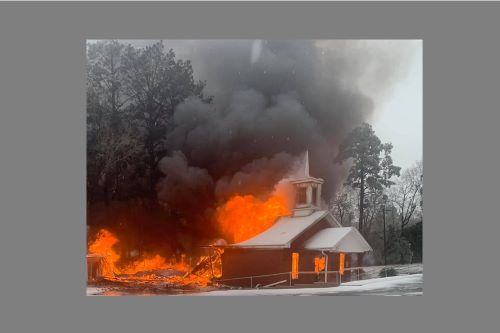
Atlanta Baptist Church Engulfed in Flames – Updated

Emergency responders were dispatched at 2:35 PM on Wednesday, February 17, 2021, to a fire in Atlanta, LA, at Atlanta Baptist Church.

Winn Parish Fire District 3 (WPFD), Winnfield Fire Department (WFD), Winn Parish Sheriff’s Office and Atlanta PD all responded to the fire.

WPFD responded with three engines, one tender and one service truck.

According to WFD Chief Brian Montgomery, “WPFD requested mutual aid from WFD at the Atlanta BC. The WFD ladder truck myself along with three other members responded to Atlanta to help with the extinguishment efforts. Upon arrival the structure was 90-95% involved. Very little could be done. Response efforts where delayed due to dangerous roadway conditions. WFD has mutual aid agreements with WPFD as well as multiple fire departments in neighboring parishes and are always ready to help when called upon.”

The cause of the fire is under investigation by the State Fire Marshall’s office.

Louisiana State Police Discourage Unnecessary Travel

A large majority of roads across #Louisiana remain impassable due to current winter weather. Weather conditions and extremely low temperatures have not allowed for any defrosting of our roadways.
 
Unnecessary travel is highly discouraged.
 
Motorists can find the most up-to-date road closure information by visiting www.511LA.org, calling 511, or downloading the Louisiana 511 smartphone application.

Winn Parish Winter Storm Closures and Cancellations – Updated

Last updated 2-17-21 10:41PM

Emergency Shelter Location 

Grove Street Recreation Center800 N Grove St, Winnfield, LA 71483

Closed – 

8th JDC CourtClosed Until Monday
Clerk of CourtClosed Wednesday & Thursday, anticipated open Friday
District AttorneyClosed Wednesday & Thursday, anticipated open Friday
Police Jury OfficeClosed Wednesday & Thursday, anticipated open Friday
Bank of WinnfieldClosed Wednesday & Thursday, anticipated open Friday
NSUClosed
Winn Parish ROVClosed Wednesday and Thursday
CLTCC Huey P. Long CampusClosed – Virtual Classes – Closed as well
Lynda’s Country KitchenClosed
Winn Community HealthClosed
Food Pantry at First Presbyterian Church Closed tomorrow Feb. 18
Sabine State BankClosed

Cancelled – 

Waste Connections Trash Pick UpCanceled Trash Collection
Rotary Club of WinnfieldCanceled Wednesday Meeting

If you have a closings or delayed open, please send the information to: 318-302-0210 or wpj@winnparishjournal.com

Winter Storm Advisory

Meteorologist Nick Mikulas
 
If anything, this system is looking more impressive on models, as more come into agreement that this should stay all freezing rain. This should overspread the area in the next couple hours, bringing some pretty incredible amounts of ice. It’s entirely possible that some locations see around an inch of freezing rain accumulate on elevated surfaces. Tree damage, and power outages are likely.
for the northern 2/3 of the area, this will be a significant ice storm.
 
Ice on the trees and elevated surfaces, not a brick on the ground like the last one. It’ll add a layer of slickness to that, but it won’t pile up as easily. So power outages will become a problem. Some models are showing over 2 inches of rain in areas that will stay near, or below freezing. The silver lining is, heavy rain can’t all become ice. Some will just roll off the power lines and onto the ground. So if an area sees 2 inches of rain, and they see heavy rain for a few hours, they may *only* see 3/4-1 inch of ice accumulation on elevated surfaces. It’s not an instant process of freezing where every drop just freezes when it lands, especially when most areas will see the heaviest freezing rain fall when we are 28-32 degrees. If it were 24-27, that could be a different story. Regardless, this will be significant. Here’s a parish by parish forecast.
 
Rapides… Mostly freezing rain. Total ice accumulation 1/4-3/4 inch. Power outages likely.
Vernon… Mostly freezing rain. Total ice accumulation 1/4-3/4 inch. Power outages likely.
Avoyelles… Mostly freezing rain in the northwest half of the parish, freezing rain could change to very cold rain in areas like Simmesport and Cottonport. Total ice accumulation 1/8-1/2 inch. Power outages possible, especially in the northwest part of the parish.
Grant… Mostly freezing rain. Total ice accumulation 1/2-1 inch. Power outages likely.
Sabine… Mostly freezing rain, maybe a little sleet. Total ice accumulation 1/2-1 inch. Power outages likely.
Natchitoches… Mostly freezing rain, maybe a little sleet. Total ice accumulation 1/2-1 inch. Power outages likely.
Winn… Mostly freezing rain, maybe a little sleet. Total ice accumulation 1/2-1 inch. Power outages likely.
Lasalle… Mostly freezing rain. Total ice accumulation 1/4-3/4 inch. Power outages likely.
Caldwell… Mostly freezing rain, maybe a little sleet. Total ice accumulation 1/2-1 inch. Power outages likely.
Catahoula… Mostly freezing rain. Total ice accumulation 1/4-3/4 inch. Power outages likely.
Concordia…. Mostly freezing rain. Total ice accumulation 1/4-3/4 inch. Power outages likely.
Tensas… Mostly freezing rain. Total ice accumulation 1/4-3/4 inch. Power outages likely.
Beauregard… Freezing rain likely changing to rain in the afternoon. Especially in southern, and southeastern parts of the parish. Total ice accumulation 1/8 to 1/2 inch, with highest totals in the northwest part of the parish. Power outages possible, especially in the northwestern part of the parish.
Allen… Freezing rain early changing to rain. Trace to 1/4” likely, scattered power outages possible in the northern part of the parish.
Evangeline….Freezing rain early changing to rain. Trace to 1/4” likely, scattered power outages possible in the northern part of the parish.
St. Landry… Mostly rain, but freezing rain possible early in the event in the northern part of the parish. Up to 1/8 inch of ice possible before it changes to rain in the northern part of the parish. I don’t expect major power outage issues in St. Landry Parish.
 
Light precipitation move out by late afternoon or early evening. Roads are already hot garbage, so don’t try traveling if possible. Yes, they were passable in many areas yesterday, but we are back in the mid 20s, and the sun stopped working its magic. The best case models show areas south of a Leesville to Alexandria to Jonesville line warming up to just above freezing in the afternoon.
 
I’d say 70-80% of ensembles and short range models keep us at our below 32 for the whole event.
 
Nick Mikulas is a former on air meteorologist for KALB in Alexandria LA, who now keeps all things meteorology updated on the social media side for Central Louisiana.

Winn Parish Sheriff’s Office Arrest Report

Name: Kelvin McVincent Barnes
Date: 2-9-21
Race: Black
Gender: Male
Age: 34
Charge: Driving Under Suspension W/O Accident, No Record of Insurance, Vehicle License Required

Name: Craig Griffin
Date: 2-10-21
Race: White
Gender: Male
Age: 21
Charge: Criminal Trespassing, Simple Criminal Damage to Property Over $500

Name: Jessica Davis
Date: 2-12-21
Race: White
Gender: Female
Age: 34
Charge: Prohibited Acts; Drug Paraphernalia X3, Possession Of Schedule II Drug W/Intent to Distribute, Possession of Heroin, Possession of Schedule I Drugs, Possession of Schedule II Drugs

Name: Christopher P. Frederick
Date: 2-12-21
Race: N/A
Gender: Male
Age: N/A
Charge: Prohibited Acts; Drug Paraphernalia, Possession Of Schedule II Drug W/ Intent to Distribute, Possession of Schedule I Drug W/ Intent to Distribute, Possession of Schedule I Drugs, Possession of Schedule II Drugs

Name: Michael Brett Keiffer
Date: 2-12-21
Race: White
Gender: Male
Age: 26
Charge: Unauthorized Use of a Motor Vehicle, Switched License Plate, Prohibited Acts; Drug Paraphernalia X3, Possession of Schedule II Drug W/ Intent to Distribute, Possession of Schedule I Drug W/Intent to Distribute, Possession of Schedule II Drugs 

Name: Rodney Tacuma Payton
Date: 2-11-21
Race: Black
Gender: Male
Age: 47
Charge: Failure to Appear

LHSAA Girls’ Basketball Playoff Brackets

The Louisiana High School Athletic Association (LHSAA) 2021 girls’ basketball playoff brackets are listed below.

Central Louisiana teams that made the playoffs have been broken out. Click each tab for the full bracket.

Home teams are listed second.

CLASS 5A

  • #17 Ouachita Parish vs #16 Pineville

CLASS 4A

  • #18 George Washington Carver vs #15 Bolton
  • #31 Peabody vs #2 Huntington

CLASS 3A

  • #20 Grant vs #13 Caldwell Parish

CLASS 2A

  • #17 French Settlement vs #16 Avoyelles
  • #28 Winnfield vs #5 Avoyelles Charter
  • #20 Bunkie vs #13 South Plaqumines
  • #30 Rapides vs #3 Lake Arthur
  • #26 Northeast vs #7 Rosepine

CLASS 1A

  • #22 Montgomery vs #11 Delhi Charter
  • #3 Northwood (BYE); advances to regional round

CLASS B

  • #2 Fairview (BYE); advances to regional round
  • #5 Anacoco (BYE); advances to regional round
  • #22 Doyline vs #11 Glenmora
  • #18 Pitkin vs #15 Weston
  • #19 Forest vs #14 Oak Hill

CLASS C

  • #16 Simpson vs #1 Gibsland-Coleman
  • #14 Pleasant Hill vs #3 Plainview
  • #10 Georgetown vs #7 Evans
  • #15 Central (Jonesville) vs #2 Hicks
  • #4 Reeves vs #13 Calvin
  • #11 Atlanta vs #6 Hornbeck

DIVISION I

DIVISION II

DIVISION III

  • #11 Pope John Paul II vs #6 Menard

DIVISION IV

DIVISION V

  • #1 University Academy (DOUBLE BYE); Advance to semifinals
  • #5 St. Joseph’s (Plaucheville) vs #4 Family Christian (quarterfinal round; both teams got BYE)

Houston, We Have A Problem

Curtis R. Joseph, Jr./Opinion

Like many in this part of the country, my family and I have been coping with the winter storm that has besieged our area. It goes without saying that this is unlike any Mardi Gras that I’ve ever experienced. There were no parades or socially-distanced parties to attend. In their place, were movies, comfort food, books and solitude. Nevertheless, we remain blessed to be on this side of the dirt. We have each other, food on the table and a warm house to call home. That said, there are certainly times when it’s easier to count your blessings. On other occasions, we fall too easily into the “why me” mentality. This morning was one such occasion.

As I walked through our house, checking water pressure, I came upon my daughter’s shower. I turned the faucet…nothing…not even a drip. In all of our precautionary measures, I’d failed to drip the water in her shower, which faces an outside wall. Consequently, the pipes to her shower were frozen. The homeowner in me immediately began doing the calculations. How much will this cost? And when can the plumber get to me knowing that so many others may be worse off? Once I got past the economic uncertainty, I phoned our plumber (insert shameless plug for Joe Baca with Affordable Plumbing of Shreveport), who told me exactly what I didn’t want to hear. I needed to go underneath the house with a hair dryer and thaw the pipes.

For those who do not know me, I run a notch over 6’5’’. So, crawling under a house, in tight spaces, is not my forte. But there I was, under the house, in 10-degree weather, hair dryer in hand. During the 25 minutes or so that it took to get the water flowing, I began to lose sensation in my fingertips. While I continued to direct the heat in various directions, having no idea what I was doing, my mind turned to the astronauts on Apollo 13.

Just the day before, I’d watched the Smithsonian Channel’s ‘The Real Story: Apollo 13’. The production moved between interviews with the astronauts and their ground crew and Ron Howard, who directed the movie, which featured Tom Hanks, Kevin Bacon, Bill Paxton, Ed Harris, and Gary Sinise. Many will recall the famous phrase “Houston, we have a problem”, even if they haven’t actually seen the movie. Although the essence of the phrase was, in fact, uttered by a couple of the astronauts shortly following the mechanical failure that doomed their mission, the wording was slightly tweaked by Ron Howard to add dramatic effect.

I make mention of this particular Apollo moon mission because of the way the astronauts handled themselves after the explosion that damaged their spacecraft. At that very moment, they realized that landing on the moon was no longer their objective. Not only would they be unable to land on the moon but returning safely to Earth would take a Herculean effort from them and the ground crew.

As a result of the referenced explosion, although their spacecraft carried sufficient oxygen for the return trip, they were unable to remove carbon dioxide from the cabin. One of the scientists on the ground, devised a plan for the astronauts to fashion a filter from materials that were available to them. Then, ground control communicated the protocol to the astronauts, who were able to complete the task. Problem solved. The device was referred to as “the mailbox”. Jim Lovell (the astronaut portrayed by Tom Hanks) later described the improvised device as “a fine example of cooperation between ground and space.”

But they weren’t out of the woods just yet. As the spacecraft ran low on electricity and water, the temperature inside the cabin dropped to as low as 3 degrees Celsius (38 degrees Fahrenheit). As you can imagine, making precise calculations and executing moves that require fine motor coordination in those conditions required the kind of resolve that most can never muster. The least I could do was hold the hair dryer and thaw the pipes to my daughter’s shower.

Mainly, I reference the Apollo 13 story because, during the interview with astronaut Jim Lovell, he stated that there were a few overly dramatic scenes in the film that were not accurate as it relates to what actually occurred within the close confines of their spacecraft. In fact, the three astronauts complained to director Ron Howard about the inaccuracies. But Howard insisted that the drama needed to be a part of the film “because viewers will need it”. However, according to the astronauts, given their precarious situation, more than 240,000 miles from Earth, in a hobbled spacecraft, they didn’t have time for drama. Every second counted. They had to keep their minds clear and focused.

I offer this example to stress the point that we don’t really need the drama that fills so much of our animosity toward one another. Instead, if we focused our various talents and energy on solving common problems, we can safely navigate our common vessel. After all, we’re in it together.

As the astronauts hurled toward Earth at speeds in excess of 25,000 mph, the world watched with bated breath. Jack Gould of The New York Times stated, “Apollo 13, which came so close to tragic disaster, in all probability united the world in mutual concern more fully than another successful landing on the Moon would have.” They’d worked together to turn tragedy into triumph. On April 17, 1970, they landed safely in the Pacific Ocean. And, after those pipes in my daughter’s shower thawed, I took the best shower I’d ever taken.

The views and opinions expressed in the My Opinion article are those of the authors and do not necessarily reflect the official policy or position of The Winn Parish Journal. Any content provided by the authors are of their opinion and are not intended to malign any religion, ethnic group, club, organization, company, individual or anyone or anything.

Acquittal: A Recap of the Latest Impeachment Sham

By Royal Alexander/Opinion

This has been a fraudulent, politically motivated show trial that has ignored both constitutional law and the requirements of due process

The three principal reasons this second impeachment was a sham are these:

1). The Senate did not have jurisdiction to hear this case because President Trump is no longer president; he is a private citizen, and the Constitution requires removal of a sitting president. 2). Even if the Senate retained jurisdiction to hear the case, everything President Trump said on Jan 6th is constitutionally protected speech under our First Amendment and did not nearly rise to the level of incitement. 3). President Trump was not afforded due process during this rushed impeachment effort.

There were essentially two grounds of acquittal and Senators, sitting as jurors in the case, had a right to vote to acquit on either ground.

The first is that the Senate had no jurisdiction to hear the case because President Trump was no longer the president and the Constitution requires removal of the president. Chief Justice Roberts’ refusal to preside over the impeachment trial highlights its illegitimacy.

The second ground is that even if Senators believed the Senate retained jurisdiction to hear the case even though President Trump was no longer president, President Trump’s speech on Jan 6th was constitutionally protected speech. As such, there is simply no credible argument for impeachment on grounds of incitement.

This was constitutionally protected speech because the “Brandenburg principle” stands for the landmark proposition that “core political speech” amounts to incitement and may be prohibited only when there exists “a clear and present danger of imminent lawless action.” Here, President Trump used the words “peacefully and patriotically make your voices heard” to describe the actions he anticipated which means he was asking his supporters to march and demonstrate with their voices and nothing else. This is not incitement. This is core political speech used as part of a political protest and President Trump, and all of us, are entitled to engage in this form of speech.

[In addition, the breach occurred while President Trump was still speaking, which mortally wounds the allegation that Trump’s words stirred up the crowd. There is also mounting evidence that the Capitol attack was preplanned].

By the way, if President Trump’s comments are the legal standard for what qualifies as “incitement” and “insurrection,” what about the highly inflammatory comments made by Democrat members of Congress last year that unquestionably encouraged and condoned rioting by mobs who attacked cities and committed an orgy of property destruction, arson, violence, and murder.

For that matter, recall the 2018 Supreme Court nomination hearing of Justice Brett Kavanaugh. That insurrection involved hundreds of Democrat protestors who stormed their way into the Capitol, charged into the hearing room, and interrupted the hearing while threatening lawmakers as they yelled and screamed. They cornered Senators in the hearing room, hallway and even in their offices. Senators and Senate staffers said they felt frightened, intimidated, and overwhelmed by the mob fearing they would be physically injured or even killed. However, there was no resulting media outrage and Nancy Pelosi and Chuck Schumer later defended the protest and protestors because it occurred in the “People’s House.” Do you see the hypocrisy?

Finally, this rushed impeachment scheme unquestionably violated President Trump’s due process rights by not providing he and his defense team an opportunity to mount a defense to and/or formally challenge the articles of impeachment.

This incident never ever rose to the level of an impeachable offense. Rather, it has been a politically motivated effort to convict President Trump so he could then be disqualified from ever running for president again. This farce has undermined our Constitution and the rule of law and the acquittal is necessary, just, and timely.

The views and opinions expressed in the My Opinion article are those of the authors and do not necessarily reflect the official policy or position of The Winn Parish Journal. Any content provided by the authors are of their opinion and are not intended to malign any religion, ethnic group, club, organization, company, individual or anyone or anything.

Remember This? Daniel’s Three Days

Daniel was a political activist and pamphleteer in London, England, during the late 1600s and early 1700s.  Pamphlets were a popular medium for authors to broadcast their opinions to a wide audience in that era because they were unbound and inexpensive.  Authors shared their opinions in pamphlets as a way to shape public opinion.  Daniel’s pamphlets were often controversial and critical of the English government.  Daniel had earned a significant income from his writing, and was a sort of regional celebrity.  With each pamphlet, Daniel’s following grew. 

King William III usually overlooked Daniel’s writing because Daniel usually defended the king.  In March, 1702, King William III fell from his horse and broke his collarbone.  While recovering, he developed pneumonia.  On March 8, 1702, fifty-one-year-old King William III died.  Forty-six days later, on April 23, 1702, William III’s sister-in-law and cousin, Anne, who was next in the line of succession of the throne, was crowned Queen at Westminster Abbey.  Hostility erupted in England following King William III’s death and with the accession of Queen Anne to the throne. 

In December of 1702, Daniel published a 29-page satirical pamphlet entitled “The Shortest Way with the Dissenters”.  Daniel realized the controversial pamphlet would be received with criticism from some, therefore he published it anonymously.  Within a short time, however, critics of the pamphlet traced it back to Daniel.  At that time, England had no freedom of speech, nor did they have freedom of the press. 

Queen Anne went on the offensive against political activists, including Daniel.  He was arrested, charged, and, in a short trial presided over by Judge Salathiel Lovell, found guilty of criticizing and provoking dissatisfaction with the English government.  The notoriously sadistic judge sentence Daniel to a punitive fine of 200 marks, three days in a pillory, and an undetermined prison term which would only end after the fine was paid and once the judge was satisfied that he had learned his lesson.

The stocks and the pillory were often placed on scaffolding so everyone would have a good view, and in busy locations.  The stocks and the pillory were meant to punish the prisoner and to show those who witnessed the punishment what could happen to them if they acted out. The pillory was a form of punishment by public embarrassment which is now considered cruel and unusual punishment in most countries.  Many people confuse the pillory with lesser form of punishment called the stocks.  Stocks held prisoners in a seated position with their ankles locked into two wooden boards attached together with a hinge.  (As recent as 2020, police in Chinu, Columbia, locked people in stocks who broke COVID-19 quarantine.)  The pillory consisted of a pole which held two wooden boards with holes for the prisoner’s hands and head.  Rather than seated, as with the stocks, the pillory was designed so the prisoner would have to stand, usually in an uncomfortable, crouching position. 

When people in the surrounding area heard that someone was to be locked into the pillory, they began making preparations.  With few things to take their minds off of their day-to-day lives, they saw the pillory as a form of entertainment.  They gathered items to throw at the prisoner.  Many people spent hours taunting the helpless prisoners.  Some people spat on and cursed the prisoner, while others threw rotten fruits and vegetables.  The prisoner’s hands and head were secured in such a way that he was unable to wipe away the various waste from his face.  For the most despised of prisoners, their turn in the pillory was much worse.  Rather than rotten fruits and vegetables, the crowd threw more substantial items such as stones, sticks, and anything which would cause pain and suffering.  On some occasions, the prisoner was pelted to death.  There was no recourse taken against members of the crowd if a prisoner died in the pillory. 

On July 31, 1703, jailers led Daniel to the pillory.  The crowd roared when they saw Daniel.  The jailers led Daniel up the steps and onto the scaffolding.  One of the jailers opened the top board of the pillory, force Daniel’s head and hands inside, and let the top board slam shut.  The cheering crowd watched their every movement.  Another jailer secured the lock.  Remember, Daniel would have to spend three days straight, a total of seventy-two hours, locked in the pillory.  He would have no bathroom breaks, no opportunity to sit, no opportunity to eat or drink anything unless members of the crowd pitied him, which was unusual, and no opportunity to sleep.  If a prisoner fell asleep, the wood surrounding his neck would cut off his air supply.  Three days in the pillory must have seemed like an eternity for even the strongest of men.

 As was to be expected, the crowd had carefully selected items to throw at the prisoner.  Even before the jailers were clear of the pillory, the crowd began their ritual of hurling objects at the prisoner.  To the jailers’ surprise, the crowd did not throw stones, nor did they throw rotten fruits and vegetables.  This crowd was made up of people who agreed with what Daniel had published in his pamphlets.  They were fans.  Rather than stones and rotting food, the crowd threw roses.  They brought food and drink for Daniel.  The jailers kept anyone from climbing the steps to the pillory, so members of the crowd tied various types of food and cups of drinks onto long sticks and carefully lifted them up to Daniel’s lips.  Several people in the crowd stayed with Daniel the entire three days. 

On August 3rd, jailers released Daniel’s hands and head from the pillory.  Daniel had survived three long days in the pillory with little injury other than exhaustion.  Within a short time, Daniel secured enough funds to pay the fine and was released.  He later wrote that his time in the pillory would stay with him forever.  Had the crowd been against Daniel and throne stones instead of roses, it is likely that he could never have written the book which is purportedly second only to the Bible in its number of translations.  Sixteen years after his three days in the pillory, Daniel wrote a book about a castaway who spent 28 years on a remote desert island.  Daniel Defoe titled the book after the lead character, Robinson Crusoe.  


  Sources:

  1. Lee, William. Daniel Defoe the First Volume of His Writings: His Life and Recently Discovered Writings, Extending from 1716 to 1729. Philadelphia: Pennsylvania State University, 1869.

LDWF Warns Public of Potential Fish Kills Due to Freezing Temps

As an arctic blast continues to move across the state, the Louisiana Department of Wildlife and Fisheries warns the public of potential fish kills throughout coastal Louisiana due to freezing water temperatures.  

It is still too early to determine if the cold temperatures will have any impact on fish populations, however. If fish kills do occur, the fish could be on the bottom of water bodies and may not be visible for a week or more.   

Coastal species commonly impacted by low water temperatures are sand seatrout, (a.k.a. white trout), red drum, black drum, and spotted seatrout.

“Typically, water temperatures below 40 degrees Fahrenheit for any more than a day cause problems for spotted seatrout, whereas red drum are slightly more tolerant and will begin to experience problems in the mid-30s,” explained LDWF fisheries biologist Jason Adriance. “The rate at which the water cools is also important. If fish have a chance to acclimate and move, the potential for survival is higher.”

More definitive estimates of the freeze effects on fish population sizes and distribution within the coastal areas will be available as information is collected through the department’s fishery-independent monitoring programs. 

Inland fisheries biologists are not expecting serious impacts to freshwater gamefish.  There is the potential for small isolated die-offs of shad due to the colder than normal water temperatures, but this should not pose a significant impact to sport fishermen.

Should you come across significant numbers of dead or dying fish, LDWF encourages you to contact the department. Contact information, along with requested reporting specifics, is available here: https://www.wlf.louisiana.gov/page/fish-kills.  Be prepared to provide your name, phone number (in case additional information is needed), along with the location, including good directions to the fish kill site, the approximate quantity and species of fish, and their condition (still dying, all dead, decomposing, etc.).

People should also be aware that legal creel and size limits are in effect, and the harvest of fish beyond those limits is illegal.

The Louisiana Department of Wildlife and Fisheries is charged with managing and protecting Louisiana’s abundant natural resources. LDWF receives no state general funding and depends on license sales as a major funding source.  Help us protect your hunting and fishing heritage while preserving habitat, wildlife, and aquatic resources by purchasing your license at www.wlf.la.gov. To receive email or text alerts signup here